
How Does Pest Infestation Work Mtg: Complete Guide to Pests, Tokens & Synergy
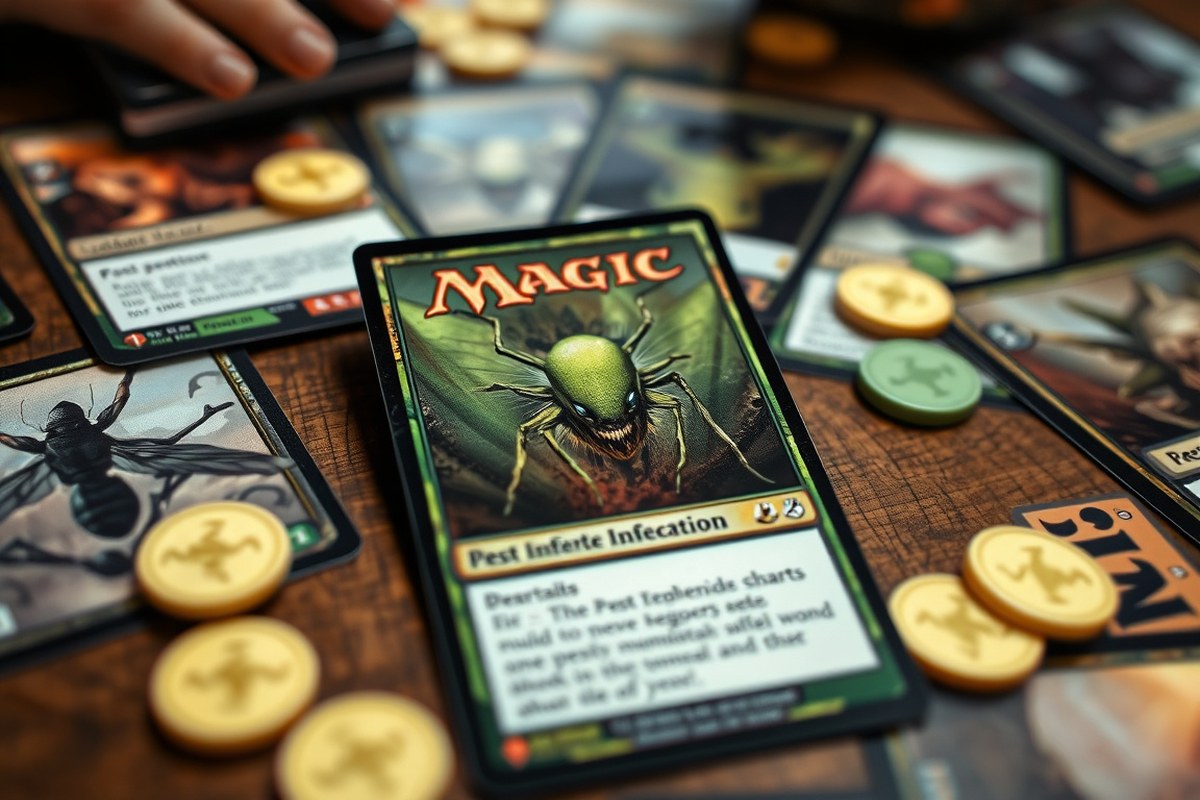
Pest Infestation in Magic: The Gathering is a sorcery that lets you destroy X target artifacts and/or enchantments and then create X 1/1 green Pest creature tokens. Its spell cost is XXG, meaning you pay two green mana plus twice the number value you choose for X. Understanding how does Pest Infestation work MTG revolves around balancing the number of permanents you want to remove with the tokens you wish to generate.
This card is mainly used in Commander format and fits well in decks focused on token creation and sacrifice synergies. You will learn how Pest tokens interact, which colors and decks maximize Pest Infestation’s potential, and which strategies help you avoid common mistakes. The article covers effective combos, comparisons to other token spells, and tips for multiplayer games using Pest Infestation.
Key Takeaways
- Pest Infestation’s cost depends on sacrificing creatures, creating X 1/1 Pest tokens equal to their power with life-gain triggers on death.
- Pest tokens grant life gain upon death and interact well with sacrifice and removal effects, supporting board presence and resilience.
- Green and black decks, especially Golgari colors, best use Pest Infestation through synergistic creature sacrifices and token generation.
- Combos with cards like Beledros Witherbloom or Containment Breach maximize Pest token production and life-drain advantages.
- Compared to other token generators, Pest Infestation trades creature sacrifices for life gain and multiple tokens, balancing cost and benefit efficiently.
- Playing Pest Infestation optimally involves timing sacrifices to create tokens before key combat phases or removal spells resolve.
How Pest Infestation Works and Its X Cost Explained

Pest Infestation is a sorcery card that creates multiple Pest creature tokens based on the power of a creature you sacrifice. Its X cost sets the number of tokens made, and these tokens have life gain abilities tied to attacking and dying. Sacrificing creatures is key to triggering the token creation and making the most of Pest Infestation’s effects during gameplay.
Pest Infestation Card Text Breakdown
Pest Infestation costs {X}{B/G}{B/G}, where X is variable alongside two hybrid black/green mana. When you play it, you must sacrifice a creature whose power is exactly X, then generate two times X 1/1 Pest tokens in black and green. Each Pest token has the triggered ability: “When this token dies, you gain 1 life.” For example, sacrificing a creature with power 3 results in producing six Pest tokens. The strength of this card lies in converting one creature into a massive group of Pest tokens.
The card’s text also dictates that you must sacrifice the creature during the resolution of Pest Infestation, not before casting. This timing means you decide X when you cast the spell, then sacrifice the matching power creature. This interaction keeps the spell balanced, linking the number of tokens directly to the creature you give up.
Calculating X and Sacrificing Creatures for Tokens
The value of X determines how many Pest tokens you get and costs as much mana as decided when casting. Planning your mana for X is important. You’ll want to choose a creature to sacrifice whose power aligns with your intended X and fits your mana budget. The higher the X, the more creatures you create but the more mana you must spend. Here is how you play Pest Infestation step by step:
- Choose a creature on your battlefield to sacrifice and note its power.
- Decide on the value of X equal to the sacrificed creature’s power.
- Pay {X}{B/G}{B/G} mana to cast Pest Infestation.
- On resolution, sacrifice the chosen creature.
- You create twice X 1/1 black and green Pest tokens, each carrying the life gain trigger: “When this token dies, you gain 1 life.”
- Use the Pest tokens immediately, remembering they are not affected by summoning sickness if created during your main phase.
A practical example: say you sacrifice a 4/4 creature with power 4, paying {4}{B/G}{B/G} mana. Pest Infestation then creates 8 Pest tokens. These tokens can attack next turn to gain life and add pressure.
Pest Token Abilities and Life Gain Triggers
Pest tokens created by Pest Infestation are 1/1 black and green creatures that have a death-triggered ability giving you 1 life whenever they die. This ability means you gain incremental life when pests trade in combat or are otherwise destroyed. In multiplayer, this can become a steady source of life gain and drain, especially when many tokens are on the battlefield.
Since the tokens gain life only on death, attacking with them triggers life gain only if the token dies, thanks to the updated rules text stating “Whenever this token attacks, you gain 1 life.” This means every attack grants you one life per attacking Pest, supplementing the death triggers. The tokens’ synergy with sacrifice effects and life gain creates a multiplier effect that benefits decks focused on draining life and controlling the board.
Understanding Pest Tokens and Their Interactions

Pest tokens in Magic: The Gathering are artifact creatures with the Pest subtype, possessing unique triggered life gain abilities. They interact closely with sacrifice outlets, counters, and tribal synergies, making them useful in decks focusing on these aspects. Understanding their characteristics helps you maximize their value on the battlefield through strategic plays and card combinations.
Physical Attributes of Pest Tokens
Pest tokens typically start as artifact creatures with a 0/1 or 1/1 toughness and power, depending on the specific card generating them. They are usually small and fragile but can grow stronger by accumulating +1/+1 counters through various triggers. Their size and toughness make them well-suited for early blocking or as fodder for sacrifice effects, while their numbers can overwhelm opponents when generated in large quantities. Maintaining a board presence of Pest tokens requires balancing token generation with boosting effects or counters to keep them relevant over time.
Most Pest tokens come with a low mana cost or no mana cost when created, which allows you to flood the board quickly. They can also be artifact creatures, which opens synergy with artifact-specific support cards and removals. Their initial fragility means they need some external help to survive combat or removal, but once improve, Pest tokens become threatening both offensively and defensively.
Creature Typing and Classification
Pest tokens always have the creature type Pest, which is important when building tribal synergies. Because Pests are a distinct subtype, they can benefit from cards that specifically boost or interact with Pests. They also often appear alongside related types like Insect, Bat, Snake, or Spider in some decks, especially in Commander format, allowing versatile support from cards that affect those tribes.
Decks that include Pest tokens often use their tribal type to trigger effects from cards that care about Pests or any combination of these subtypes. For example, cards like Blex, Vexing Pest provide global buffs such as +1/+1 bonuses to all Pest, Bat, Insect, Snake, and Spider creatures, increasing your tokens’ effectiveness. Since Pests count as artifacts in some cases, this intersection adds flexibility in how you build around these tokens.
Triggered Abilities Unique to Pests
The key ability that Pest tokens share is a death trigger that grants you life whenever a Pest dies. This life gain is often small, such as gaining one life per Pest death, but it can accumulate quickly in token-heavy decks. This effect helps stabilize your life total while providing additional advantage from losses on your board. It also fuels other abilities that trigger on life gain, creating a feedback loop that makes playing Pest tokens more rewarding the longer the game lasts.
Also, Pest tokens can acquire +1/+1 counters through repeated life gain or other effects, which increases their power and toughness. This growth transforms originally weak tokens into formidable creatures later in the game. When combined with sacrifice strategies, sacrificing a Pest with counters can yield significant benefits, such as boosting other creatures or triggering additional life gain.
Synergies with Support and Buff Cards
You get the best results with Pest tokens by pairing them with cards that capitalize on their death triggers, life gain, or artifact classification. Sacrifice synergies or Aristocrat-style effects turn Pest tokens into valuable resources rather than mere blockers. Each Pest sacrificed can provide life gain triggers, increment counters on other creatures, or fuel creatures with devour abilities.
Cards like Blex, Vexing Pest amplify every Pest on board, granting +1/+1 counters and producing life gain triggers when they die. Hornbeetle can convert life gain into even more tokens, increasing your board presence automatically. These support cards multiply the effectiveness of a single Pest token over time, creating a snowball effect that pressures opponents and sustains your life total.
Interactions in Multi-Token Scenarios
As your board fills with Pest tokens, their interactions become complex and powerful. Each token’s death triggers life gain, which can simultaneously trigger other abilities and counter placements. This chain can result in multiple creatures growing larger or generating further tokens, depending on your deck choices. However, managing multiple death triggers requires careful sequencing to maximize benefits and avoid wasting triggers.
Sacrificing multiple Pest tokens at once boosts creatures with devour or map counters and gains you life that can trigger additional effects or card draws. Maintaining a balance between token creation, counter distribution, and sacrifice timing is key to turning numerous weak tokens into a dominant board state. Overcommitting without support leaves your tokens vulnerable to sweepers, losing your life gain and sacrificial resources.
Be mindful of the order in which Pest tokens die in multi-token scenarios; properly sequencing sacrifices and triggers can maximize life gain and counter distribution.
Best Colors and Decks That use Pest Infestation
Pest Infestation works best in black and green decks, especially in Commander where its potential shines. These colors offer the right mix of ramp and sacrifice outlets that let you cast it for a high X value, turning your mana into a swarm of 1/1 Pest tokens that can block or fuel other synergies. Green provides the ramp and creature support, while black offers sacrifices and removal, creating a cohesive strategy around creating many small creatures and sacrificing them for value.
In Commander, Pest Infestation often finds a home in Golgari (black/green) decks that focus on token generation, +1/+1 counters, or life gain. These archetypes benefit from the constant influx of Pest tokens to either protect key creatures or planeswalkers or to sacrifice for cards and other triggers. Decks that include commanders like Chatterfang, Squirrel General, or build around synergistic cards such as Golgari Charm and Butcher of Malakir use Pest Infestation to maintain pressure and board presence.
There are options for both budget and competitive players. Pest Infestation itself is affordable, starting around €0.37, making it accessible to many players who want to explore token or sacrifice-based strategies. Competitive decks lean heavily into maximizing their mana ramp and sacrificing potency to get the most out of Pest Infestation and related cards. Less experienced players might want to start with more casual builds focusing on straightforward token synergies.
- Golgari (black/green) colors with commanders like Chatterfang, Squirrel General
- Decks with heavy ramp to support higher X values for Pest Infestation
- Token-focused archetypes using Pest tokens for defense or sacrifice fodder
- +1/+1 counters or lifegain decks that benefit from recurring small creatures
- Casual and budget decks using affordable Pest Infestation copies and simple synergies
- Competitive builds combining removal spells and sacrifice outlets with Pest token generation
Running Pest Infestation effectively requires a mana base that supports green for ramp, as casting it at a high value increases the number of Pest tokens and the strategic payoff. Sacrifice outlets and removal spells that interact well with the generated tokens amplify the card’s usefulness. Watching your mana carefully and timing Pest Infestation to protect important creatures or planeswalkers can make a big difference. Neglecting support in ramp or sacrifice can lead to underwhelming results despite the card’s potential.
Key Synergies and Combos Involving Pest Tokens
Pest tokens shine when paired with cards that either generate more pests or improve their power and resilience. Legendary creatures like Blex, Vexing Pest, and Moseo, Vein’s New Dean not only produce Pest tokens but also offer additional benefits such as pumping your pests, granting lifelink, or providing evasion with flying. Doubling Season is a popular spell that doubles the number of Pest tokens you create and doubles any +1/+1 counters placed on them, making an already overwhelming swarm much harder to deal with.
Blex, Vexing Pest, for example, is a 2G legendary creature that gives all your Rats, Snakes, Spiders, and Pests +1/+1, turning individual pests into more formidable threats. By activating Blex’s ability, you can capitalize on the life gained from your pests to cast extra spells, effectively doubling your tempo in a turn. Moseo, Vein’s New Dean lands with a 1/1 Pest token, enabling immediate board development while flying provides defensive utility. Doubling Season, although costly, exponentially increases your board presence and works best in decks that consistently produce Pest tokens each turn.
One of the strongest synergies involves combining Pest token generators with cards that benefit from creatures dying or from entering the battlefield. For example, Blech, Loafing Pest, a legendary 3/4 Pest for 1BG, triggers abilities tied to creature arrivals. This creates constant triggers in a deck focused on pests, as the continuous token production fuels these effects. Pairing these with cards that care about +1/+1 counters or lifelink can easily turn a Pest token swarm into a winning board state.
- Blex, Vexing Pest pumps pests and allows casting additional spells using life gained.
- Moseo, Vein’s New Dean creates a Pest on arrival and flies for evasion.
- Doubling Season doubles Pest tokens and +1/+1 counters for explosive growth.
- Blech, Loafing Pest triggers abilities on creature arrivals to generate value.
- Beledros Witherbloom produces Pest tokens each upkeep, providing constant pressure.
The key to maximizing these combos lies in playing a long game that use constant Pest token production with incremental buffs through pumping effects or token doublers. Pest tokens typically are small and fragile, so you want to build a board that grows over time or benefits from tribal boosts. Avoid relying solely on tokens without support, or your swarm may be wiped out easily.
Comparing Pest Infestation to Other Token Generators
Pest Infestation stands out among token generators for its unique combination of creating tokens and forcing opponents to sacrifice creatures. Comparing it with similar cards like Hunt for Specimens and Send in the Pest reveals key differences in cost, token quantity, and effects that influence their use in different deck strategies.
| Card | Mana Cost | Token Created | Additional Effect | Best Use Cases |
|---|---|---|---|---|
| Pest Infestation (SOC #282) | 3G (4 mana total) | 1 Pest Token (TSOC #23) | Target player sacrifices a creature | Midgame board control and token synergy |
| Hunt for Specimens (VOW #21) | 2G (3 mana total) | 1 Insect Token (TVOW #13) | Discovery mode with lesson card synergy | More efficient token production in decks with lessons |
| Send in the Pest (Black) | 1B (2 mana total) | No token | Each opponent discards a card | Multiplayer discard effects, disrupt opponents’ hands |
Pest Infestation costs more than Hunt for Specimens by one mana but compensates with forcing an opponent’s creature sacrifice, which can slow aggressors or remove key blockers. Pest Infestation also creates a Pest token which can synergize with pump or sacrifice strategies. Hunt for Specimens is cheaper and better in decks built around lessons or with a low mana curve, enabling faster early token generation. Send in the Pest, while not producing tokens, fits mono-black decks well and excels in multiplayer formats by disrupting multiple opponents’ hands at once, especially valuable when a discard plan is central to your strategy.
Choosing between these depends on your deck colors, tempo, and goals. Pest Infestation suits decks that want steady board growth paired with opponent disruption. Hunt for Specimens offers cheaper, more frequent tokens and lessons for spells, fitting aggressive or blinkier decks. Send in the Pest fits low-cost black decks focusing on hand disruption while still offering some interaction with tokens indirectly by pressuring opponents’ resources.
Use Pest Infestation when you want to slow your opponent’s board state and gain a reusable threat, but switch to Send in the Pest for faster, multiplayer discard effects that can tilt games in your favor early on.
Optimizing Gameplay with Pest Infestation Step-by-Step
To play Pest Infestation effectively, prioritize casting it early with enough mana to generate useful tokens, then use those tokens for life gain and board control. Invest mana efficiently, use sacrifices to increase token impact, and chain life gain with buffs and triggers. Timing your plays based on your deck’s synergies and match situation will maximize Pest Infestation’s value.
Mana Investment and Timing
Start by preparing to pay the mana cost that yields a meaningful number of Pest tokens. Pest Infestation requires you to pay X plus 3 mana, and you need at least 5 mana invested to produce a single 0/1 Pest token, although higher mana investments scale your token count up.
Casting Pest Infestation early benefits you by getting a token on the battlefield and triggering life gain effects swiftly. Aim to cast it as soon as you can comfortably pay at least 5 mana to push your board presence forward while keeping mana open for interaction or token support spells. In multiplayer or Commander, start with Pest Infestation on turn 4 if possible.
Sacrifice Strategies for Optimal Tokens
Sacrificing tokens pays off well because each Pest dying triggers life gain and maintains board control. Cards like Vampiric Rites let you pay two mana plus a token sacrifice to draw a card and gain life, extending your resources. In decks running Pitiless Plunderer, sacrifice also generates Treasure tokens, making each Pest even more valuable.
When early aggression isn’t viable, sacrifice tokens strategically to clear blockers or protect key creatures while triggering benefits. Avoid sacrificing all tokens at once, keep a critical mass on board to benefit from effects that buff or protect your Pest tokens.
Maximizing Life Gain and Board Presence
Build your board by repeatedly casting Pest Infestation with higher X values in mid to late game phases, especially if you have commanders or cards like Blech that add counters whenever you gain life. Each Pest token gained interacts with these effects to grow your creatures rapidly, turning a modest board into a threat.
Use cards or lands that grant life when they enter or boost token durability, such as those that give Indestructible until end of turn or produce Food tokens, so you can sacrifice or attack without losing momentum. Using triggers from life gain along with buffs turns your growing swarm of pests into a formidable force that pressures opponents consistently.
- Plan to invest at least 5 mana on your initial Pest Infestation cast to get your first Pest token efficiently.
- Cast Pest Infestation as early as turn 4 or 5 to start building your token base, adjusting for your deck’s mana curve.
- Use Vampiric Rites or similar sacrifice outlets to draw cards and gain life by sacrificing Pest tokens, maintaining card advantage.
- Retain some Pest tokens on the battlefield to benefit from continuous life gain buffs and keep pressure on opponents.
- Increase X in Pest Infestation casts as game progresses to produce more tokens and fuel synergies with commanders or board buffs.
- Activate lands or create conditions that grant life when tokens enter or by keeping tokens alive longer for increased triggers.
- Sacrifice tokens strategically to remove blockers, generate resources like Treasure tokens, or trigger life gain without crippling your board.
- Attack with a wide token board once sufficient counters and buffs accumulate to maximize damage and trigger effects on damage or life gain.
Common Mistakes and How to Avoid Them Playing Pest Decks
Players often struggle with managing their mana and triggers when playing Pest decks. Overcommitting mana early on can leave you vulnerable to board wipes or removal spells, as you won’t have the resources to rebuild effectively. It’s important to balance your spending so you have reserves to respond after your initial deployment of Pest tokens.
Misunderstanding how Pest tokens interact with triggers can also lead to missed opportunities. For example, many Pest tokens have attack triggers that generate additional value when they deal combat damage. Missing the timing to maximize these triggers can reduce your board presence and lifegain potential.
Protecting your Pest tokens from removal and board wipes requires a mix of proactive and reactive strategies. Use cards that grant hexproof or indestructibility, or that can return tokens to your hand before a wipe occurs. Also, building redundancy in your token generation ensures you can rapidly recover even if some are removed.
- Avoid spending all your mana on Pest tokens too early, keep some for instant-speed interaction.
- Track your Pest token triggers carefully during combat to ensure you receive all benefits, such as lifegain or additional token creation.
- Include cards like Essence Warden to slowly grow your creatures alongside token production.
- Use creatures or enchantments that replace your lost tokens, such as Blight Mound, to maintain board presence.
- Protect key creatures like Blech, Loafing Pest with buffs or protective spells to keep your engine running.
- Consider sacrifice outlets or recursion effects to reuse tokens after removal effects.
- Expand your deck’s resilience by mixing in cards that grant wide board strategies, improving your ability to absorb or bounce back from wipe effects.
Many experienced Pest players rely on redundancy and synergy to overcome common pitfalls. For instance, combining Blood Artist with Pest tokens can provide both offensive pressure and life drain, turning losses into gains. Always plan your turns with potential opponent responses in mind, especially in Commander or multiplayer formats where targeted removal and board wipes are frequent. Proper timing and resource management allow Pest decks to use their token generation for sustained advantage.
Pest Infestation and Token Support in Commander and Multiplayer
Pest Infestation holds a solid position in Commander format, especially in decks that can produce numerous green mana sources to support its {X}{G}{G} cost. Its ability to generate a large number of Pest tokens while forcing opponents to sacrifice creatures makes it a powerful tool for board control. In multiplayer settings, Pest tokens can overwhelm opponents by clogging their boards, and the forced sacrifices can disrupt multiple players’ strategies simultaneously. This makes the card valuable not only for token production but also for creating political pressure during multiplayer games.
The behavior of Pest tokens in multiplayer games is critical. Each Pest token is a 1/1 black Insect creature with flying, and while individually weak, they become threatening en masse. Because Pest Infestation requires opponents to sacrifice creatures equal to the number of Pest tokens, the impact scales with the size of the multiplayer game. For the average four-player match, expect the forced sacrifices to hit multiple opponents, often forcing them to make tough decisions about which creatures to lose or whether to block differently to protect key threats. However, if your playgroup uses house rules or casual variants that limit sacrifice effects to the active player only, the card’s effectiveness can be diminished.
There are slight differences between the versions printed in Commander 2021 and Strixhaven: School of Mages Mystical Archive, though the core functionality remains the same. The Strixhaven printing benefits from being part of a set with more synergy around spells and themes like spellcasting triggers and token buffs, making it easier to find builds that maximize Pest Infestation’s disruptive potential. Commander 2021’s version is often part of preconstructed decks designed to support several token-focused strategies, offering easier access but sometimes less flexibility. Be mindful of the artwork and collector variations but focus primarily on what your mana base and supporting cards allow.
To capitalize on Pest Infestation in Commander, prepare to ramp your mana aggressively early on, ensuring you can cast it with a high X value. Combine it with cards that protect your creatures or benefit from increasing the number of friendly tokens, as Pest tokens can bolster your board presence while simultaneously thinning opponents’ forces. Watch out for board wipes and mass removal spells that can neutralize your Pest army before it triggers the sacrifice effects. Coordinate with your playgroup on whether Pest Infestation is expected or how much removal support you might face, as some metas feature heavy creature removal that can blunt your strategy.
In multiplayer, use Pest Infestation strategically to target the player with the fewest creatures first to maximize forced sacrifices across opponents and improve political use.
Step-by-Step Action Plan for Using Pest Infestation in MTG
Start harnessing Pest Infestation by understanding its cost and token generation, then build around its synergy to dominate your matches. Follow these steps to optimize your Pest-themed deck and gameplay.
- Before You Start: Study Pest Infestation’s X cost and how it creates Pest tokens equal to X. Ensure you can pay the mana cost reliably to generate a useful number of tokens.
- Day 1: Add Pest Infestation to your deck along with cards that support Black and Green, the best colors for Pest synergy. You’ll know it works if your deck can consistently cast Pest Infestation early in the game.
- Day 2: Include token enhancers like anthem effects or cards that interact with insect tokens. Confirm success when your Pest tokens gain buffs or additional abilities during play.
- Week 1: Practice the timing of casting Pest Infestation, paying attention to phases where token generation maximizes impact. If your opponents struggle to handle your increasing Pest swarm, you’re on the right track.
- Week 2: Test key combos involving Pest tokens such as sacrificing them for value or triggering token-based effects. You’ll know these combos work when your board presence increases or your card advantage grows reliably.
- After 3 Weeks: Compare your deck’s performance to other token-based decks and adjust your decklist based on what’s working or not. Improved win rates or smoother gameplay indicate progress.
- Ongoing: Avoid common mistakes like overcommitting to tokens without protection or mismanaging your mana for Pest Infestation’s variable cost. You’ll feel more confident and make fewer errors as you refine your strategy.
Frequently Asked Questions
Is Pest Infestation Good Mtg?
Pest Infestation is strong in MTG, especially in Commander, as it boosts your entire pest-themed board and fits the deck’s strategy perfectly. It synergizes well with Blech, Loafing Pest, making it a key card for pest decks.
What Is the Hardest Infestation to Get Rid Of?
The toughest infestation often depends on board state, but Pest Infestation tokens combined with creatures like Blech are difficult to clear due to their cumulative buffs and life gain effects. Managing multiple token types increases the challenge for opponents.
Do Pests Count as Insects in MTG?
Pests are a distinct creature type in MTG, separate from insects, though they may share some interactions. Certain effects target insects specifically, so Pests don’t always benefit from insect-related buffs or spells.
What Are the Best Cards to Use in an MTG Pest Deck?
Cards that generate multiple tokens or boost pests, like Pest Infestation and Blech, are best. Green cards for ramp and token support are also useful to maximize token generation and synergy in pest decks.
Can Pest Infestation Create More Than One Token per Cast?
Pest Infestation creates multiple Pest tokens based on its X cost, producing a number of 1/1 Pest creatures equal to X. This makes it scalable depending on available mana.
Does Pest Infestation Work Well Outside Commander Format?
Pest Infestation sees most play in Commander, where token synergy is strong. It’s less common in other formats due to its reliance on specific deck strategies and higher mana costs.
The Bottom Line
Pest Infestation works by converting your mana investment into a swarm of pest tokens, giving you a flexible tool for aggressive or defensive strategies. To get the most from this card, try building a deck that supports token generation and takes advantage of synergies with insect or sacrifice effects. Today, you can sharpen your gameplay by testing Pest Infestation in a casual Commander game, focusing on how to balance your mana spending with the token value you receive.


