

How to Get Rid of Log in Equations: A Complete Guide for Beginners
To get rid of a log in an equation, you convert the logarithmic form into its equivalent exponential form. This means rewriting expressions like LogB(x) = y as BY = x. Doing this simplifies the equation so you can solve for the unknown value without the log. Understanding how to get rid of log helps you handle a wide range of algebra problems involving logarithms.
This explanation is designed for students, educators, and anyone learning algebra. You’ll find clear steps on how to convert logs to exponentials, simplify logarithmic expressions, work with different bases, and avoid common mistakes. This approach also covers checking domain restrictions and validating your solutions.
Key Takeaways
- Remove logarithms by rewriting the equation in exponential form using the definition of logs, such as replacing log_b(c) = k with b^k = c.
- Simplify logarithmic expressions first by applying log rules like product, quotient, and power to reduce complexity before eliminating logs.
- Use the change of base formula, log_a(b) = ln(b)/ln(a), to handle logarithms with different or uncommon bases.
- Check domain restrictions since logs require positive arguments; verify solutions satisfy these conditions to avoid extraneous results.
- Tackle multiple or nested logs by combining them into single log terms where possible before converting to exponentials.
- Avoid common pitfalls such as ignoring domain limits, mishandling log properties, or skipping verification of solutions after removal.
What Does It Mean to Get Rid of Log in an Equation?
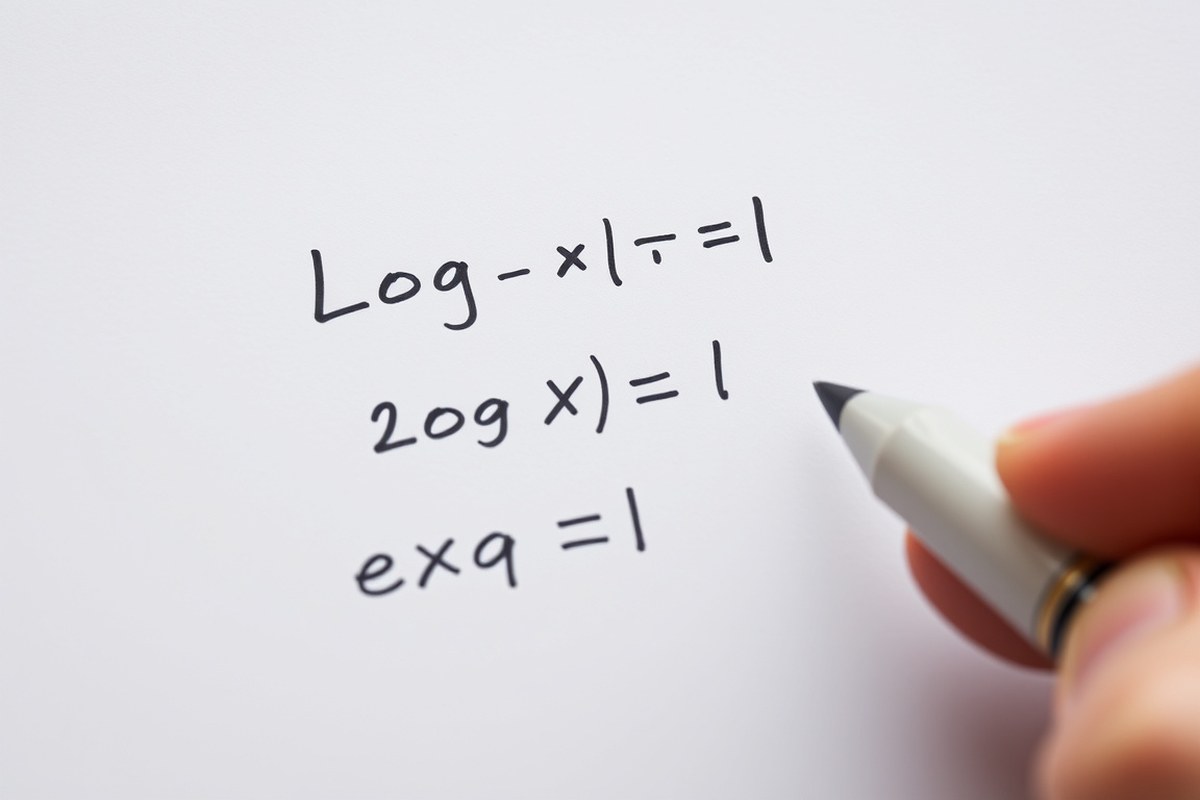
Getting rid of a logarithm in an equation means converting the logarithmic expression into an exponential form so you can isolate the variable you want to solve for. Logarithms and exponentials are inverse functions, this means that applying one after the other cancels them out. For example, if you have an equation like LogB(x) = y, removing the log involves rewriting it as X = bY. This step removes the logarithm, making the equation easier to handle because exponentials are often simpler to solve directly.
You remove logs to solve equations primarily because logarithms complicate equations by involving powers and roots. By rewriting a logarithmic equation into its equivalent exponential form, it isolates the variable by eliminating the log operation. This is much like solving a plain algebraic equation after “undoing” the log. Since logarithms answer the question “To what power must the base be raised to get a certain number?” converting back to an exponential lets you solve for the unknown directly.
The exact process relies on the fundamental inverse relationship between logarithms and exponentials. The general rule is that if you have LogB(x) = y, it rewrites as BY = x. This conversion removes the logarithm. So “getting rid of the log” means “raising the base to the power given by the other side of the equation.” For instance, if your equation reads Log10(x) = 2, you raise 10 to the power 2 and get X = 100. This removes the log and reveals the value of x directly.
Before applying this conversion, the logarithm’s base must be clear or assumed. When no base is shown, the base is usually 10, called the common logarithm. If the base is natural log (ln), meaning base e (approximately 2.718), you exponentiate with e. For example, Ln(x) = 3 becomes E3 = x. Also, in some cases, multiple logs or complicated expressions may need to be simplified before rewriting. But the core step remains the same: rewrite the log equation as an exponential to remove log and solve for the variable.
One thing that it takes to successfully remove a logarithm is clear understanding of the log’s domain restrictions. Since logarithms only handle positive arguments, variables inside the logs must remain positive after solving. Removing the log doesn’t eliminate this domain constraint, so checking solutions afterward is necessary to verify they make sense in the original equation.
The payoff of removing logarithms is that you convert the problem into something algebraic and easier. It avoids dealing with logs directly in solution steps, enabling standard techniques like factoring or using inverse operations on exponentials. This method also allows use of a calculator’s exponential functions rather than relying only on log operations. However, incorrectly converting or ignoring the base can lead to wrong answers. Misapplication might also produce extraneous solutions if you do not check the domain afterward. Still, in most cases, converting logs to exponentials is the recommended primary step to simplify and solve log equations.
Step-by-Step Method to Remove Logs by Converting to Exponentials

Removing a logarithm from an equation involves rewriting the logarithmic form into its equivalent exponential form. This conversion allows you to work with an exponential equation that is often easier to solve. You isolate the log, transform it, solve for the variable, and then check that the solutions fit the domain of the original equation.
Isolate the Logarithmic Expression
Start by getting the logarithmic expression alone on one side of the equation. This means moving all other terms, constants, variables, and coefficients, to the opposite side. Isolating the log sets you up to convert it properly to exponential form, as the conversion formula requires a logarithm equal to a single value or expression.
For example, if your equation is 3 + \log_b(x) = 5, subtract 3 from both sides to get \log_b(x) = 2. You now have the log expression isolated and ready.
Rewrite the Equation in Exponential Form
The key relationship is that a logarithm \(\log_b(x) = y\) is equivalent to the exponential statement \(b^y = x\). Use this to rewrite the isolated logarithmic equation by making the base \(b\) raised to the power of the right side equal to the argument of the log.
From the example \(\log_b(x) = 2\), rewrite it as \(b^2 = x\). This flips the problem into an exponential form that often lets you solve for the unknown variable inside \(x\) directly.
Solve the Resulting Exponential Equation
With the equation in exponential form, solve for the unknown as in a standard exponential problem. This could require simplifying powers, factoring, or using properties of exponents, depending on the complexity. The solution method depends on the base and whether the variable is in the exponent or the base.
For instance, if you have \(2^{x} = 16\), convert 16 to a power of 2, so \(2^x = 2^4\). You can then set the exponents equal, giving \(x = 4\). If bases don’t match, consider logarithms or numerical methods to solve.
Check Domain and Validate Solutions
Since the logarithmic function is only defined for positive arguments, check your solutions against the domain restrictions. Plug the solutions back into the original log expressions to confirm their arguments are strictly greater than zero. Discard any solutions that violate domain rules.
For example, if solving \(\log(x-3) = 1\) yields \(x = 2\), substitute and find \(2 – 3 = -1\), which is invalid since it’s negative. This solution must be rejected. Always check domain conditions to avoid extraneous answers.
- Isolate the log term by moving other terms to the opposite side.
- Identify the base \(b\), the exponent \(y\), and the argument \(x\) in \(\log_b(x) = y\).
- Rewrite the logarithmic equation in exponential form as \(b^y = x\).
- Solve the exponential equation for the unknown variable.
- Check your solutions by substituting back into the original log to respect domain restrictions \(x > 0\) inside the log.
- Discard any solutions that result in undefined log expressions.
Always confirm the argument of the logarithm is positive after solving; disregarding domain restrictions can lead to incorrect solutions.
How to Simplify Logarithmic Expressions Before Removing Logs
Simplifying logarithmic expressions before removing the logs makes solving equations easier and less error-prone. Use the product, quotient, and power rules to combine multiple logs into a single logarithm or rewrite logs with coefficients or powers inside the argument. Applying these rules helps you isolate the logarithmic term and prepares the equation for conversion to exponential form.
Product Rule: Log(a) + Log(b) = Log(ab)
The product rule states that the sum of two logarithms with the same base can be rewritten as a single logarithm of the product of their arguments. This rule is useful when you see expressions like Log(a) + log(b), which combines into Log(ab).
For example, if the equation has Log(x) + log(3), you can simplify it to Log(3x). This reduces the number of logarithmic terms, making it easier to isolate and solve for the variable.
Quotient Rule: Log(a) – Log(b) = Log(a/b)
The quotient rule applies when one logarithm is subtracted from another, both having the same base. It allows you to combine Log(a) – log(b) into Log(a/b). This rule is especially handy for simplifying expressions where a quotient inside the logarithm is hidden across separate terms.
For example, the expression Log(5x) – log(2) simplifies to Log((5x)/2). This step can make subsequent manipulations more straightforward and reduce confusion.
Power Rule: K · Log(a) = Log(a^k)
The power rule lets you transform a logarithm multiplied by a coefficient into a single logarithm with the argument raised to that power. This means K · log(a) can be rewritten as Log(a^k). This is useful when the logarithm has a constant factor outside, such as 3 · log(x).
For instance, 3 log(x) becomes Log(x^3). This conversion often simplifies both sides of an equation and supports combining or cancelling terms. Here is a quick reference summary of these logarithmic rules you can use to simplify before removal:
- Product Rule: sum of logs becomes log of product.
- Quotient Rule: difference of logs becomes log of quotient.
- Power Rule: coefficient of log becomes exponent inside the log.
- Log of 1 equals 0 (helps identify simplified terms).
- Log of reciprocal reverses sign: log(1/x) = -log(x).
Applying these systematically prevents mistakes like trying to remove logs before terms are combined. It also reduces complex expressions to a manageable, single log term that can be converted to an exponential equation easily. Failures to simplify often lead to extra cumbersome terms and require more steps to solve.
Handling Different Log Bases and Using Change of Base Formula
Logarithms can have different bases like 2, 4, 10, or the special number e (approximately 2.718). Each base defines its own logarithm function, and you need to handle them according to their bases when solving equations. The key fact is that Log base b of c equals k if and only if b raised to k equals c. That means for log base 2, \(\log_2 c = k\) solves \(2^k = c\); for log base 10, \(\log_{10} c = k\) solves \(10^k = c\); and for the natural logarithm (base e), \(\ln c = k\) solves \(e^k = c\).
Different bases impact how you remove the log because you need to rewrite the equation using exponentials with the matching base. Using the wrong base means you can’t correctly “undo” the logarithm. This table compares common logarithm bases and their inverse exponential forms:
| Logarithm Base | Notation | Inverse Exponential | Example |
|---|---|---|---|
| 2 | \(\log_2 x\) | \(2^y = x\) | \(\log_2 8 = 3\) because \(2^3 = 8\) |
| 4 | \(\log_4 x\) | \(4^y = x\) | \(\log_4 16 = 2\) because \(4^2 = 16\) |
| 10 (Common Log) | \(\log x\) | \(10^y = x\) | \(\log 1000 = 3\) because \(10^3 = 1000\) |
| E (Natural Log) | \(\ln x\) | \(e^y = x\) | \(\ln e^2 = 2\) |
| General base \(b\) | \(\log_b x\) | \(b^y = x\) | \(\log_5 25 = 2\) because \(5^2 = 25\) |
When faced with a logarithm of an uncommon base or when your calculator only handles natural logs or base-10 logs, the Change of base formula becomes essential. This formula lets you rewrite any log base \(b\) as a ratio of two logs with a base your calculator supports. The change of base formula is:
\(\displaystyle \log_b a = \frac{\log_c a}{\log_c b}\)
Here, \(c\) is any positive number you choose for the new base, typically 10 or \(e\). For example, to solve or calculate \(\log_4 20\) using natural logs, write:
\(\displaystyle \log_4 20 = \frac{\ln 20}{\ln 4}\)
You calculate \(\ln 20\) and \(\ln 4\), then divide the results. This lets you handle logs of any base with tools that might only support natural logs or common logs.
One risk is that you must never try to calculate logs of zero or negative numbers since they are undefined. For example, \(\log_4 0\) is not defined because \(\log(0)\) is undefined. Also, because the change of base formula involves division, make sure the denominator \(\log_c b\) is not zero; \(b\) must be positive and different from 1.
Using the change of base formula correctly saves you from getting stuck on unfamiliar bases and allows consistent methods for solving your logarithmic equations. Just pick a convenient base, apply the formula, and continue as usual with exponentials or simpler logs.
Domain Restrictions and Validating Solutions After Removing Logs
Logarithms require their arguments to be strictly positive because the logarithm of zero or a negative number is undefined in the real number system. When you remove logarithms from an equation by rewriting them in exponential form, you must keep this domain restriction in mind to avoid extraneous solutions. An extraneous solution is a value obtained algebraically that does not satisfy the original logarithmic equation due to domain violations.
Start by identifying the expressions inside each logarithm in your equation. Before solving, set inequalities ensuring each log argument is greater than zero. For example, when you have \(\log_b(x – 8)\), you must have \(x – 8 > 0\), so \(x > 8\). These restrictions define the domain of valid inputs. Ignoring them may lead to including solutions where the logarithm’s input is zero or negative, which makes the original expression invalid.
After you solve the equation, often resulting from converting logs to exponentials, check if your solutions satisfy the domain restrictions. Substitute each solution back into the original arguments of the logs. When substitution results in zero or a negative number inside any log, discard that solution as extraneous. For example, consider the equation \(\log_2(x – 8) = 3\) which leads to \(x – 8 = 8\) and thus \(x = 16\). Here, \(x=16\) makes the argument positive and is valid. Suppose another solution appeared like \(x=2\); substituting would yield \(\log_2(2 – 8) = \log_2(-6)\), which is undefined, so discard it.
To avoid common pitfalls, always keep a checklist when dealing with equations involving logs: first, write down the restrictions for all log arguments; second, solve the equation algebraically; third, substitute the solutions into the original log arguments to verify they lie within the allowed domain. This process prevents accepting invalid results.
When equations have multiple logarithmic terms, each with a distinct argument, apply domain restrictions to all arguments. The domain of the overall equation becomes the intersection of all these individual conditions. Failing to consider every log’s domain can result in partial or incorrect solution sets.
Never skip domain verification after removing logarithms; substituting solutions back into each log argument prevents adopting invalid answers.
In some cases, the domain restrictions can simplify solving the problem. For example, knowing \(x > 1\) is required but your algebraic solution yields values less than 1 allows you to disregard those without further testing. However, be cautious with complex expressions inside logs, like rational functions or polynomials, as their domain restrictions might be less obvious and require careful inequality solving.
When working with natural logarithms \(\ln(x)\) or logs of any base, the domain rule that \(x > 0\) holds universally. This means that even when you switch logarithm bases using the change of base formula, you do not change domain restrictions. The core principle remains: arguments inside all logarithms must stay positive to keep the equation valid.
Solving Equations Involving Multiple Logs and Nested Logarithms
Solving equations with multiple logarithms and nested logs requires combining terms and carefully isolating the logarithmic expressions before removing them. Whether you encounter sums or differences of logs or functions like log(log(x)), the key is to use log properties to rewrite the equation, then convert logarithms to exponentials. This approach helps you solve the equation step by step while checking domains and ensuring the solution makes sense.
Combining Multiple Logs into One Term
When sums or differences of logs appear, such as log(x) + log(y) or log(a) – log(b), apply logarithm rules to combine these into a single log term. Simplifying this way makes it easier to isolate the logarithm and remove it by converting to an exponential. The product rule (log A + log B = log(AB)) and the quotient rule (log A – log B = log(A/B)) are essential here.
Sums inside a log, like log(x + y), cannot be separated into simpler log terms and must be treated as a single argument. Often, isolating the log expression on one side allows removal by exponentiation. Example: Solve log(x) + log(x – 1) = 1
- Combine using the product rule: log(x(x – 1)) = 1
- Rewrite as log(x² – x) = 1
- Convert to exponential form: x² – x = 10¹ = 10
- Solve quadratic: x² – x – 10 = 0 → (x – 5)(x + 2) = 0
- Check domain: log arguments must be positive; x = -2 is invalid
- Accept solution: x = 5
Addressing Nested Logarithmic Functions
Nested logarithms like log(log(x)) require treating the inner logarithm as a separate function first. Begin by isolating the outer log, then rewrite the equation stepwise. This often involves setting the inner log expression equal to a new variable to simplify the equation before removing logs. Example: Solve log(log(x)) = 2, assuming base 10 logs.
- Rewrite as log(y) = 2 where y = log(x)
- Convert outer log: y = 10² = 100
- Replace y: log(x) = 100
- Convert inner log: x = 10¹⁰⁰
- Verify domain: x must be positive and log(x) must be defined
This approach breaks down nested logs into sequential steps, handling each log layer separately before solving.
Isolating the Logarithm Before Exponentiating
Removing a logarithm requires isolating it on one side of the equation. This step may involve first combining multiple logs into a single term or managing nested logs as described. After isolation, rewrite the log equation in its exponential form using the log base.
When the logs have different bases, convert them to a common base using the change of base formula before combining or isolating. Always consider domain constraints to exclude invalid solutions that would cause undefined logarithms.
- Isolate the logarithmic expression on one side of the equation
- Convert the logarithm equation to its corresponding exponential form
- Solve the resulting exponential or algebraic equation
- Check that all solutions keep logarithm arguments positive
- Discard any solution violating domain restrictions
Common Mistakes When Removing Logs and How to Fix Them
One common error when removing logarithms is ignoring the domain of the logarithmic function. Logs are defined only for positive arguments, so taking a logarithm of zero or a negative number is invalid. Always check the domain restrictions before and after solving equations involving logs to avoid incorrect or extraneous solutions.
Misapplying logarithm properties is another frequent mistake. For instance, students sometimes try to split or combine logs without confirming that the terms satisfy the required conditions, like ensuring positive inputs. Use the log product, quotient, and power rules only when their conditions hold true, and apply them carefully to rewrite expressions before removing the log.
Introducing extraneous solutions often happens during the transition from logarithmic to exponential form. Since logarithmic equations are only equivalent on their restricted domain, solving the exponential equation may yield additional answers that don’t work when plugged back into the original log equation. Always verify each proposed solution by substituting it back into the original log format.
Removing natural logs (ln) and common logs (log base 10) follows the same principle: rewrite the logarithmic equation in exponential form using their respective bases, e or 10. The key difference lies in the base itself. For example, if you have ln(x) = a, convert this to x = eA. If log(x) = b, convert this to x = 10B. Both allow calculators to evaluate without trouble, but the base choice impacts how you interpret and solve the equation.
- Failing to check the domain before solving equations with logs
- Mistakenly applying log properties to non-positive values
- Forgetting to verify solutions in the original logarithmic form
- Confusing the bases when converting between logarithmic and exponential equations
- Neglecting that both ln and log share the same properties, differing only by base
- Assuming natural logs require different removal steps from common logs beyond the base change
- Overlooking that improper manipulation can introduce non-solutions
Correct these by always determining where the expression inside the log is positive, carefully applying logarithmic identities to valid terms only, and testing every solution against the original equation. Remember that removing logs consists of rewriting with the appropriate exponential base, e for natural logs and 10 for common logs, followed by checking domain restrictions and solutions. This approach prevents common pitfalls and ensures valid answers whether working with ln or log.
Practical Tips, Tools, and Real-World Uses of Removing Logs
Using calculators designed for logarithms can significantly speed up verifying your answers after removing logs. Scientific calculators usually have dedicated log (log base 10) and ln (natural log) buttons, allowing you to plug in your solution back into the original logarithmic equation. Online algebra solvers, such as Wolfram Alpha or Symbolab, let you input the entire equation to check both numeric and algebraic solutions with step-by-step explanations. These tools are handy for confirming that exponentiating both sides of the equation was applied correctly and that no domain restrictions were violated.
The methods for removing logarithms extend neatly to logarithmic inequalities, though you must be cautious about how the inequality direction changes when multiplying or dividing by a negative number during exponentiation. After clearing the logs, interpret the inequality in terms of the original base of the logarithm, usually bases greater than 1, to maintain consistency. Verifying these solutions is important using a calculator or graphing tool since invalid domains or reversed inequality signs can mislead you.
In real-world applications, converting from logarithmic to exponential form helps interpret phenomena like sound intensity measured in decibels or population growth modeled by continuous compounding. For example, logarithmic equations describing the intensity of earthquake waves can be rearranged by removing logs to find the actual wave amplitude or energy. Understanding the exponentiated form makes it easier to grasp what the variable represents, such as time, concentration, or frequency, rather than an abstract logarithmic value.
Remembering the steps to remove logs can be simplified with a mnemonic: “First Isolate Logarithm, Next Exponentiate, Lastly Solve and Check.” This reminds you to isolate the logarithmic expression first, then rewrite the equation in exponential form by raising the base of the log to the power of the other side of the equation. Always finish by solving for the variable and checking if your solution fits the allowed domain of the original log expression.
Another practical tip is to avoid incorrectly splitting logarithms of sums or differences, as log of (x + y) cannot be broken down into log x + log y. Sticking to these mnemonics and rules helps you avoid common pitfalls during the process.
Always verify solutions after removing logs using calculators or algebra solvers to avoid mistakes caused by domain errors or sign changes in inequalities.
Step-by-Step Action Plan to Get Rid of Logs and Solve Logarithmic Equations
Follow these clear steps to remove logarithms correctly and solve equations or simplify expressions involving logs. Each phase helps you build confidence and check your progress.
- Before you start: Identify all logarithmic expressions and note their bases. Confirm the domain restrictions to avoid invalid solutions. You’ll know this worked if you clearly outline which values of the variable are allowed.
- Step 1: Simplify logarithmic expressions first by combining logs using product, quotient, or power rules. Your expression should have as few logs as possible, ideally one per side of the equation.
- Step 2: Use the definition of logarithms to convert each log to an exponential form, isolating the variable. This step works when rewriting \(\log_b(x) = y\) as \(b^y = x\).
- Step 3: Solve the resulting exponential equation for the variable. Confirm your algebraic manipulation by checking if each step yields a simplified expression moving toward \(x\).
- Step 4: Verify all solutions against the domain restrictions identified earlier to filter out invalid answers. Only keep solutions where the arguments of original logs remain positive.
- Step 5: For multiple or nested logs, apply the above method iteratively, simplify first, then convert, solve, and check domains at each stage. You’ll know this worked if you end up with valid numeric answers.
- After solving: Cross-check your final answers by plugging them back into the original logarithmic equations to confirm both sides match. This confirms the logs were properly removed and the solution is correct.
Frequently Asked Questions
What Cancels Out Log?
Exponentiation with the log’s base cancels out the log. Raising the base to the logarithm’s value returns the original number inside the log.
How to Change from Log to Normal?
Rewrite the log equation as an exponential equation using the definition of logarithms. For example, log base 10 of x equals y converts to 10^y = x.
How Do You Get Rid of a Log in an Equation?
Convert the logarithmic equation to its equivalent exponential form based on the log’s base. This eliminates the log and allows you to solve for the variable inside.
How Do I Unlog a Number?
Apply the exponential function with the same base as the original logarithm. For instance, if y = log base 10 of x, then x = 10^y.
Can I Remove a Log from an Inequality the Same Way as an Equation?
You can remove logs from inequalities by converting them to exponentials, but you must reverse the inequality sign if the base is between 0 and 1.
Does the Base Affect How to Eliminate a Log?
Yes, the base determines the exponential form you’ll use. Always raise the base to the power of the log expression to remove the log correctly.
Final Thoughts
Removing logarithms is all about converting them into exponential form to solve equations more clearly and accurately. You can start practicing today by picking a simple logarithmic equation and rewriting it without logs, checking your work by plugging your answers back in. This approach builds your skills and confidence, especially with more complex problems involving different bases or nested logs.


